How Nobel implant treatment is planned digitally
Guided surgery narrows the gap between the plan and the result — it does not close it
Why planning software gets a page
Because “we use digital planning” appears on nearly every implant clinic’s website, and almost none of them say what it does, what it is called, or where it stops being reliable.
The tools below are real and they genuinely change outcomes. They also get oversold, in a specific way that is worth naming before anything else.
What the software actually is
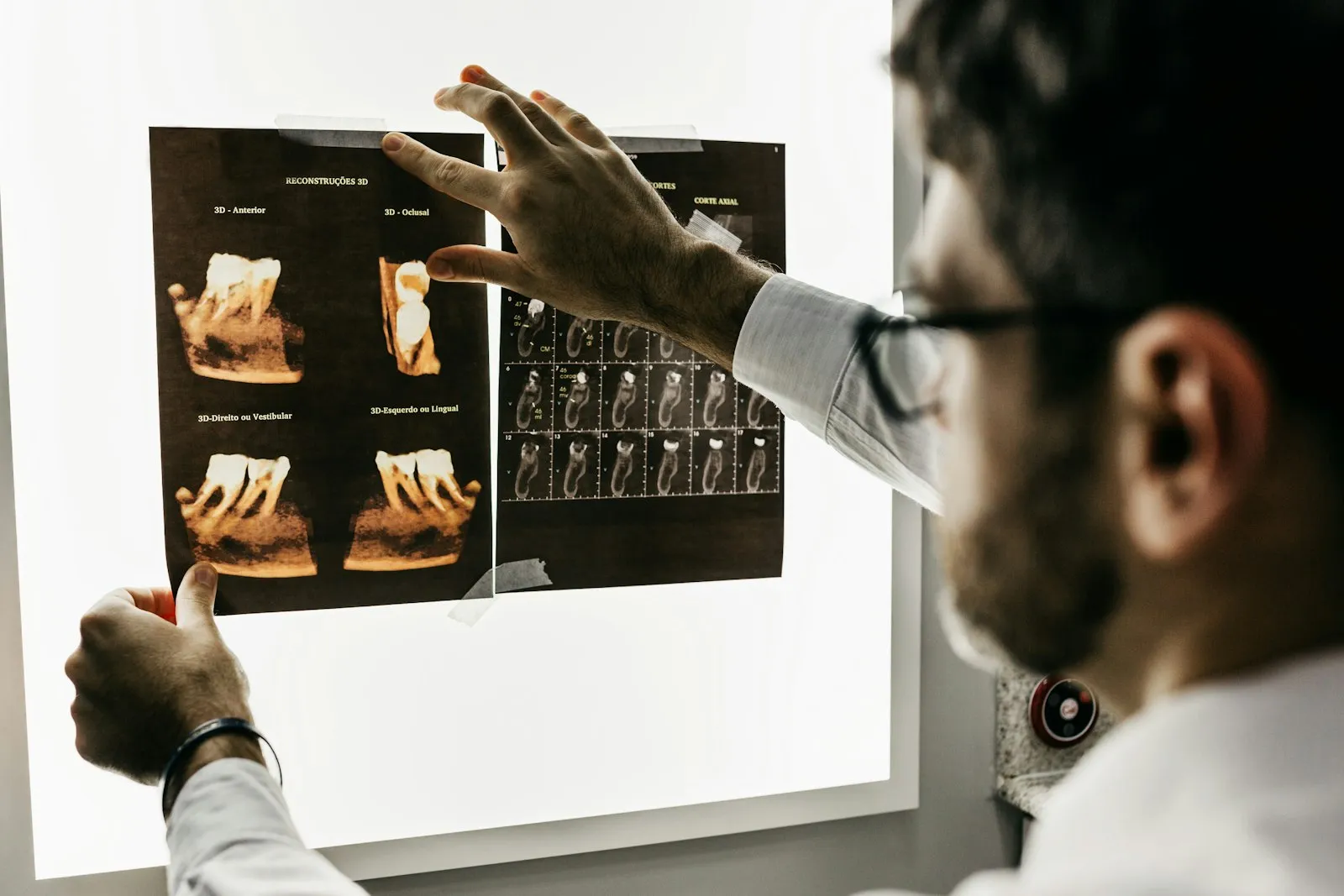
DTX Studio — the planning environment. Your CBCT scan, an intraoral or model scan and, where taken, facial photographs are combined into one three-dimensional record. The implant is positioned in that record before anything is positioned in you.
What that changes: the implant is placed where the tooth needs to be, then checked against the bone that is actually there — rather than placed where the bone is easiest and the tooth designed around it afterwards. That order is the whole point, and it is why the scan comes first.
NobelGuide — static guided surgery. The plan becomes a physical surgical guide that sits on the teeth, the gum or fixation pins, with metal sleeves that constrain the drills to the planned positions.
X-Guide — dynamic navigation. Instead of a physical guide, the handpiece is tracked in real time against the plan, and the surgeon watches position, angle and depth on screen while drilling. It adjusts during surgery in a way a printed guide cannot.
TempShell — a provisional restoration designed from the plan before surgery, so temporary teeth can be fitted at the time of placement rather than made afterwards. It only matters where immediate loading is appropriate, and whether it is appropriate is decided at surgery.
Photogrammetry — precise optical measurement of where multiple implants ended up, used for full-arch cases where a conventional impression struggles to record several implants accurately.
The limit, stated plainly
Guided surgery does not eliminate the risk of error.
The manufacturer’s own instructions for use say so, and it is the sentence most clinic marketing leaves out.
The gap between plan and result comes from a chain, and every link adds a little:
- The scan itself — resolution, movement, artefact from existing metalwork
- How the plan is aligned to the anatomy
- How the guide is manufactured
- How the guide seats in the mouth on the day — a guide that rocks is a guide that lies
- Play between drill and sleeve
- Bone that deflects a drill in a direction the plan did not predict
- Soft tissue, and how much of it was there when the guide was designed
None of this makes guided surgery a bad idea. It makes the claim of a perfect result an untrue one. Guidance narrows the distribution of outcomes; it does not collapse it to a point. Every guided case still requires the surgeon to verify what is happening rather than trust the plan.
What this means for you as a patient
A CBCT scan is not optional for planning. A panoramic radiograph shows height and not width, and width is what decides whether an implant fits between the nerve and the sinus rather than into either.
“Computer-guided” is not a quality grade. It describes a method. A well-planned freehand case by an experienced surgeon can produce a better result than a poorly planned guided one — the plan is the part that matters, and the guide only executes it.
Ask to see the plan. The planning software produces a picture a patient can understand: where each implant goes, at what angle, and how much bone is around it. If a clinic has planned your case digitally, showing you is a two-minute job. If they cannot show you, the planning may not have happened in the way the word implies.
Same-day teeth are decided in surgery, not in software. TempShell prepares a provisional in advance; whether it can be fitted depends on the stability measured at placement. A plan cannot promise it, and a clinic promising it before surgery is promising something it will not know until the day.
Where the N1 protocol differs
The Nobel Biocare N1 system is described by the manufacturer as a protocol rather than a fixture alone, with its own osteotomy preparation and its own component range. Planning is part of that system rather than a layer added on top of it — which is the substance of the distinction covered on the N1 system page.
The reasonable summary
Digital planning is genuinely better than doing it by eye, and every serious implant clinic uses it. What it is not is a guarantee, and the clinics that present it as one are describing software they have bought rather than the judgement it is meant to support.
The right question is not “do you use guided surgery?” — nearly everyone will say yes. It is “can you show me my plan, and tell me what you will check during surgery?” That one is harder to answer without having done the work.